The Webinar Archive

A curated repository of research briefings and strategic analysis for the Webinar sector.

C
ContentClik in Webinar

The Hidden AI Attack Surface: How GenAI Tools Expand Data Exposure Risk

As AI adoption accelerates, 93% of companies are already using or planning to use AI, security teams are confronting a new and rapidly expanding attack surface. Employees now feed sensitive data into tools like ChatGPT, Copilot, Gemini, and internal AI assistants, often without guardrails. This session breaks down how AI tools create new pathways for data exposure, privilege escalation, accidental data sharing, and unauthorized access. Attendees will learn how to identify hidden exposure risks, deploy Generative AI tools securely, and implement governance safeguards that reduce breach and compliance risk without slowing innovation. Speakers:  Opper, Sr Solutions Engineering Leader, Lightbeam Opper is a senior solutions engineering leader with deep expertise in data security, governance, and access control across cloud and hybrid environments. He works closely with security and IT leaders to help them understand where sensitive data lives, who can access it, and how to reduce risk without disrupting the business. Known for his practical, real-world approach, Opper bridges technical depth and executive strategy to deliver measurable security outcomes. Wes Kennedy, Sr Product Marketing Manager, Lightbeam Wes Kennedy is Senior Product Marketing Manager at Lightbeam, where he leads go-to-market strategy and builds content that translates complex infrastructure, AI, and data security technologies into clear customer value. With a background that spans virtualization administration, sales engineering, and principal technical marketing roles, Wes has helped bring to market solutions across data security, hyperconverged infrastructure, cloud-native data platforms, and distributed databases. When he’s not talking about data security and AI, Wes is usually in the shop woodworking, tackling a house project, or out in the garden. He lives in the Columbus, Ohio area with his family.
Jun 17, 2026 8 min read Premium
C
ContentClik in Webinar

How to Calculate Your Take-Home Salary

Your take-home pay, also known as net pay or net salary, is the amount of money you receive after specific deductions such as tax, national insurance, pension contributions and student loan payments have been made from your gross monthly salary. Your gross monthly salary is the total amount you earn as an employee each month. This gross figure has had none of the necessary deductions applied. Both gross and take-home salary will be outlined on your payslip, including a breakdown of your deductions. On your payslip, you will also find your payroll number and tax code, which impacts how much tax and national insurance you pay. The tax code you are assigned, and therefore the proportion of your salary you will be required to pay in tax and national insurance, depends upon the amount you earn per month. It is important that you receive a payslip each time you are paid and keep them safe for future reference. Some companies use online systems, so their payslips are accessible via a website or portal. If you are an employee or a casual worker, you are entitled to a detailed payslip. Whilst your payslip will help you to understand your take-home salary and how it is reached, it is useful to be able to calculate your net salary for yourself. The process means you will learn more about how deductions are calculated and will gain an understanding of the different thresholds and factors that influence them. It also means you will easily be able to sense-check your payslips. Every employee has different salary deductions relating to their circumstances and salary grade. They will, therefore, have differing take-home salaries.

Jun 17, 2026 8 min read Premium
C
ContentClik in Webinar

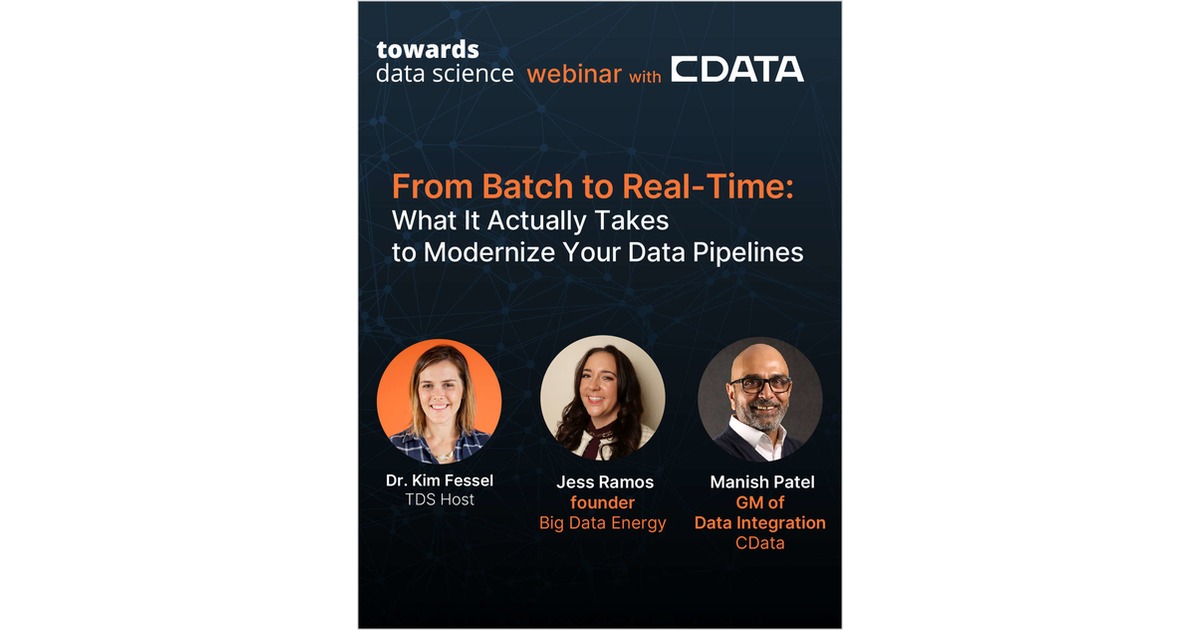
From Batch to Real-Time: What It Actually Takes to Modernize Your Data Pipelines

Most data teams know their pipelines need to evolve. Batch loads that run overnight, manual workflows stitched together over the years, legacy tooling that was never designed for the demands of real-time analytics or the AI agents that are about to depend on them. But the challenge is figuring out where to start, what to prioritize, and how to modernize without turning it into a six-month replatforming project. The stakes are higher than they used to be. Agentic RAG systems retrieve and reason over live enterprise data and they're only as reliable as the pipelines feeding them. Stale batch data, inconsistent schemas, and siloed sources don't just slow down your analysts. They cause agents to retrieve the wrong context and fail in production. In this session, Kim Fessel joins Jess Ramos of Big Data Energy and Manish Patel, GM of Data Integration at CData, to talk through what pipeline modernization actually looks like in practice. We'll cover when CDC is the right move versus when it's overkill, how to approach hybrid environments where legacy and cloud systems need to coexist, and what separates teams that modernize incrementally from those that get stuck in planning mode. We'll also walk through how CData Sync fits into this, from CDC across sources like SQL Server and Oracle, to pipeline orchestration and delivery into open table formats like Delta Lake and Iceberg, the same formats underpinning retrieval in modern agentic RAG architectures. Can't join us live? Register anyway and we'll send you a recording after the session. By registering, you consent to receiving email communications from Towards Data Science and CData. You may opt out at any time.

Jun 17, 2026 8 min read Premium

Ready for Full Access?

Gain unlimited access to our entire library of research briefings and analyst reports.

Unlock Full Membership
Access Granted
An Executive from a Global Firm just accessed Research Briefing