The Asset Archive

A curated repository of research briefings and strategic analysis for the Asset sector.
C
ContentClik in Asset

Community Hospital Speeds EHR and SQL Applications with V-locity I/O Reduction Software

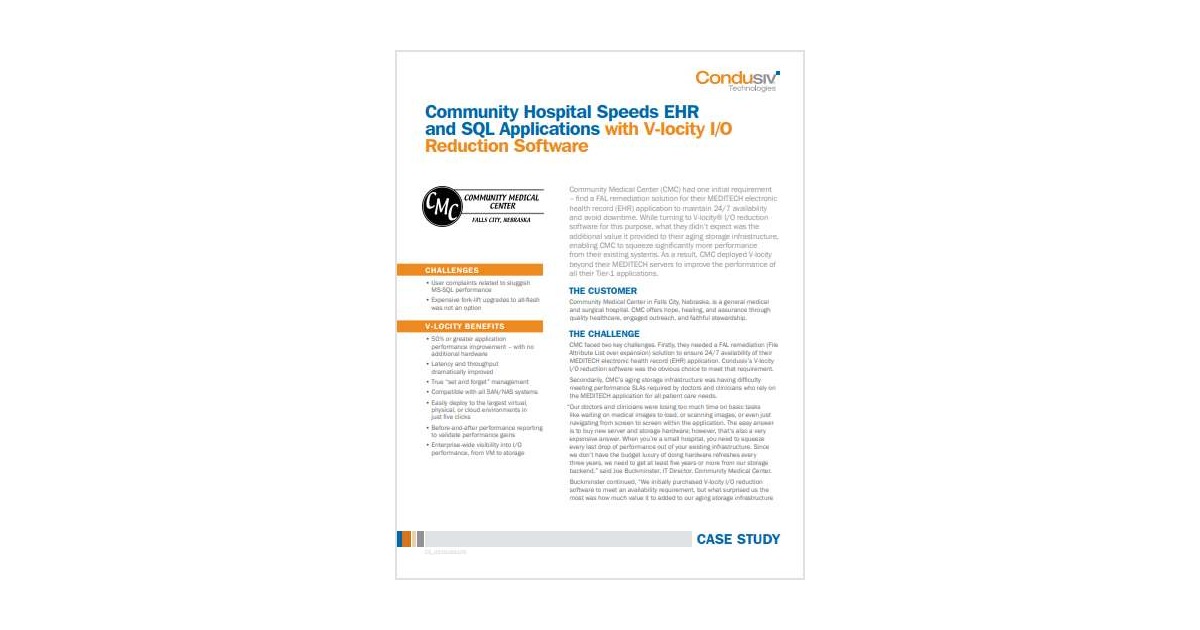
Community Medical Center (CMC) had one initial requirement-- find a FAL remediation solution for their MEDITECH electronic health record (EHR) application to maintain 24/7 availability and avoid downtime. CMC faced two key challenges. Firstly, they needed a FAL remediation (File Attribute List over expansion) solution to ensure 24/7 availability of their MEDITECH electronic health record (EHR) application. Condusiv’s V-locity I/O reduction software was the obvious choice to meet that requirement. Secondarily, CMC’s aging storage infrastructure was having difficulty meeting performance SLAs required by doctors and clinicians who rely on the MEDITECH application for all patient care needs. While turning to V-locity® I/O reduction software for their first challenge, what they didn’t expect was the additional value it provided to their second challenge-- their aging storage infrastructure, enabling CMC to squeeze significantly more performance from their existing systems. As a result, CMC deployed V-locity beyond their MEDITECH servers to improve the performance of all their Tier-1 applications. “Regarding cost savings, the value we receive from V-locity in not having to worry about our MEDITECH systems crashing due to FAL growth is invaluable. It doesn’t take long for downtime to accumulate into hundreds of thousands in lost revenue. However, the real surprise was the performance gains on our heaviest workloads,” said Joe Buckminster, IT Director, Community Medical Center Buckminster continued, “There’s no way we would have achieved a 5 year lifecycle on our storage system without V-locity offloading so much I/O traffic from that subsystem. We had no idea how many I/O operations from virtual server to storage were essentially wasted activity due to Windows write inefficiencies chewing up IOPS or hot data that is more effectively served from available DRAM.”

Jun 17, 2026 8 min read Premium
C
ContentClik in Asset

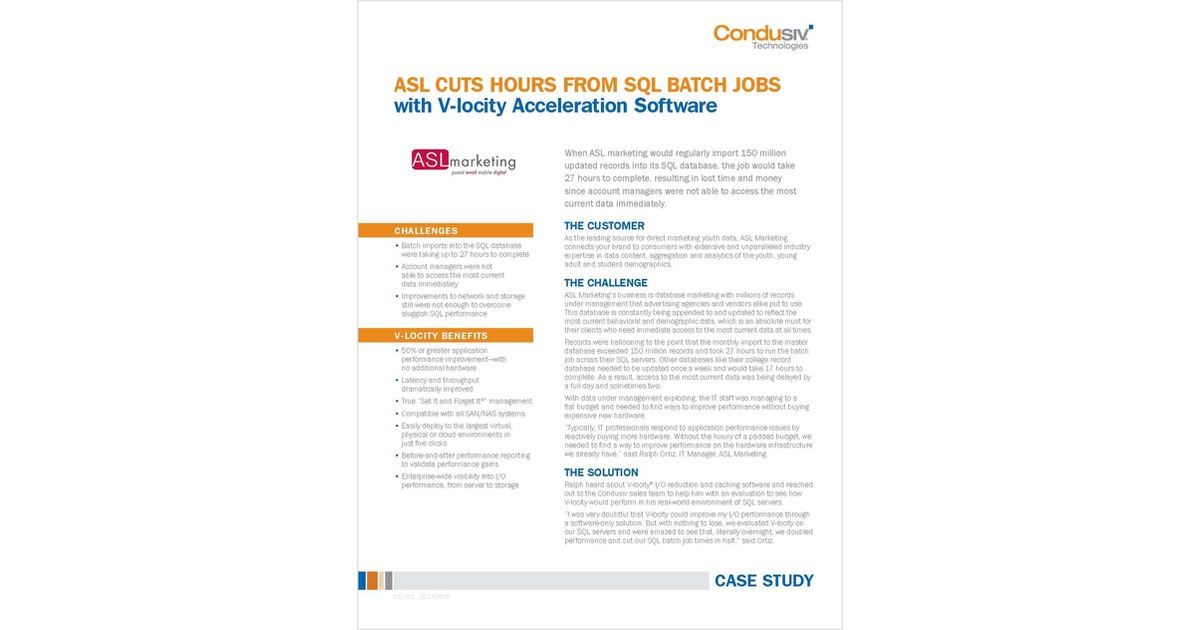
ASL Cuts Hours From SQL Batch Jobs With V-locity I/O Reduction Software

SQL Batch Imports Dropped from 27 Hours to 12 Hours - a 15 Hour Reduction ASL Marketing’s business is database marketing with millions of records under management that advertising agencies and vendors alike put to use. This database is constantly being appended to and updated to reflect the most current behavioral and demographic data, which is an absolute must for their clients who need immediate access to the most current data at all times. Records were ballooning to the point that the monthly import to the master database exceeded 150 million records and took 27 hours to run the batch job across their SQL servers. Other databases like their college record database needed to be updated once a week and would take 17 hours to complete. As a result, access to the most current data was being delayed by a full day and sometimes two. With data under management exploding, the IT staff was managing to a flat budget and needed to find ways to improve performance without buying expensive new hardware. "Typically, IT professionals respond to application performance issues by reactively buying more hardware. Without the luxury of a padded budget, we needed to find a way to improve performance on the hardware infrastructure we already have," said Ralph Ortiz, IT Manager, ASL Marketing. "I was very doubtful that V-locity could improve my I/O performance through a software-only solution. But with nothing to lose, we evaluated V-locity on our SQL servers and were amazed to see that, literally overnight, we doubled performance and cut our SQL batch job times in half," said Ortiz.

Jun 17, 2026 8 min read Premium
C
ContentClik in Asset

Increasing VDI Density with V-locity

Many people find themselves in the position of having to quickly increase the number of VDI instances on their existing infrastructure to support remote users.  You may be asking yourself the question: How can I do this without having to roll out a bunch of new hardware? Since VDI operates on the premise that not every instance is active at any one point in time, VDI relies on the ability to over-allocate system resources such as CPU and memory.  The same is generally thought to be acceptable with storage and network.  However, the effect of lots of activity from multiple virtual machines (VDIs) being sent to resources, that are generally much slower than CPU and memory, guarantees that storage, and potentially your network, will become a serious bottleneck at critical times.  This is generally referred to as the I/O Blender Effect. There will be many times during the average workday where the underlying theory of inactivity holds true.  However, there will be LOTS of times when a substantial number of desktops become active at or about the same time.  Now by time, we are not talking about an hour or even just a 10-minute period of time.  We are talking about intervals of milliseconds or at most a few seconds.  Think of that exit ramp from the freeway.  Most of the day there are just a couple of vehicles exiting so waiting for them isn’t a big deal.  But what about during rush hour?  What about when the 3 vehicles in front of you become 50 or 100 or more?  If you’re anything like me the blood pressure rises, and happy times are not upon you.

Jun 17, 2026 8 min read Premium
C
ContentClik in Asset

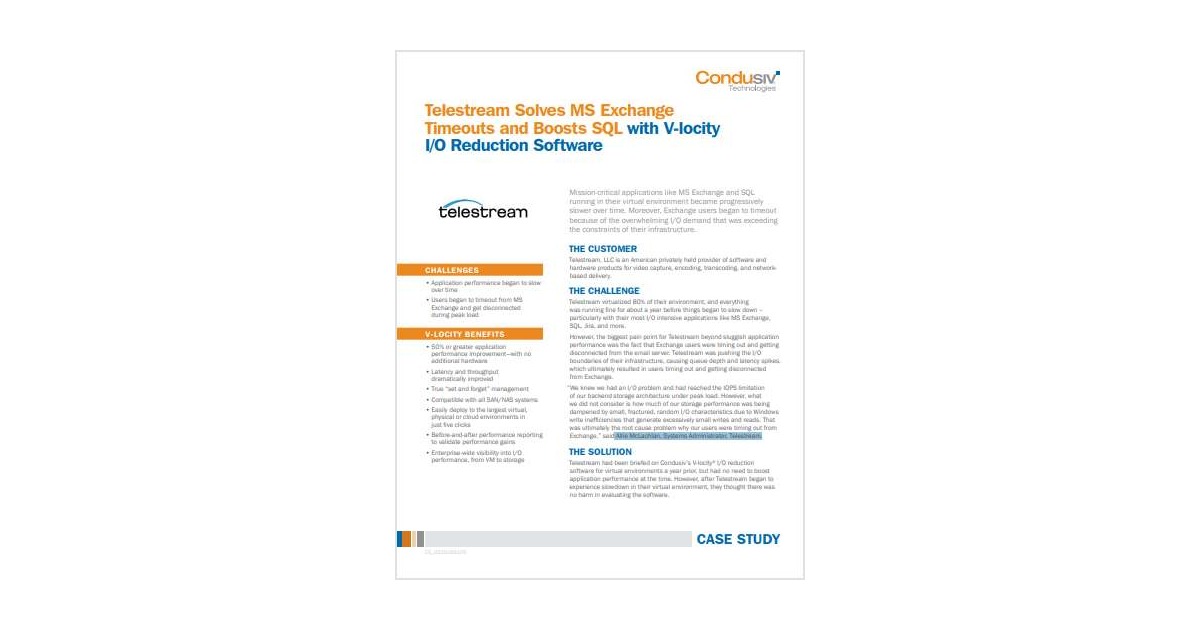
Telestream Solves MS Exchange Timeouts and Boosts SQL with V-locity I/O Reduction Software

Telestream application performance began to slow over time and users began to timeout from MS Exchange and get disconnected during peak load times. Telestream virtualized 80% of their environment, and everything was running fine for about a year before things began to slow down – particularly with their most I/O intensive applications like MS Exchange, SQL, Jira, and more. However, the biggest pain point for Telestream beyond sluggish application performance was the fact that Exchange users were timing out and getting disconnected from the email server. Telestream was pushing the I/O boundaries of their infrastructure, causing queue depth and latency spikes, which ultimately resulted in users timing out and getting disconnected from Exchange. Telestream had been briefed on Condusiv’s V-locity® I/O reduction software for virtual environments a year prior, but had no need to boost application performance at the time. However, after Telestream began to experience slowdown in their virtual environment, they thought there was no harm in evaluating the software. “As soon as we installed V-locity and saw the Exchange timeouts disappear, and users were no longer getting disconnected from Exchange, that made our purchase of V-locity I/O reduction software a ‘no brainer,’” said Allie McLachlan, Systems Administrator, Telestream. “The most eye-opening experience was finding out how badly our system performance was being taxed by small, fractured, random I/O from Windows write inefficiencies. We would have had no idea that was even an issue without trying V-locity to solve those root cause performance issues.”

Jun 17, 2026 8 min read Premium

Ready for Full Access?

Gain unlimited access to our entire library of research briefings and analyst reports.

Unlock Full Membership
Access Granted
An Executive from a Global Firm just accessed Research Briefing