The Asset Archive

A curated repository of research briefings and strategic analysis for the Asset sector.

C
ContentClik in Asset

HR Manager's Legal Alert for Supervisors Newsletter: March 1 Edition

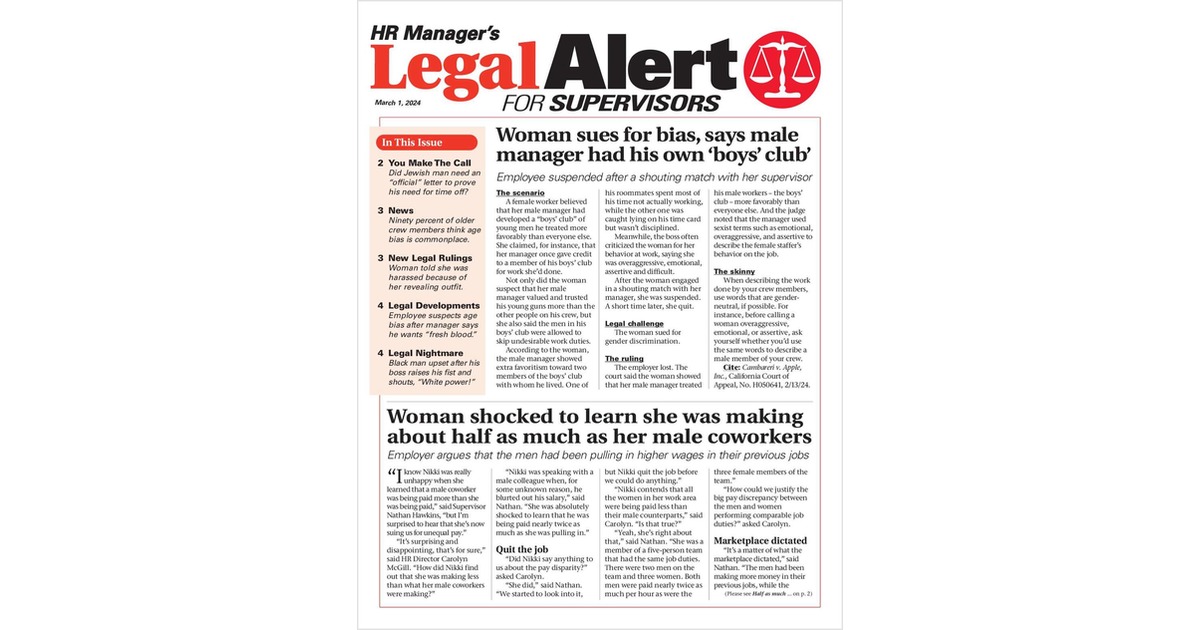
Download the current issue of HR Manager’s Legal Alert for Supervisors now! For a limited time, you – and your supervisors – can start benefitting from the hard-hitting, actionable ideas in HR Manager’s Legal Alert for Supervisors right now – without any obligation to pay or do anything – you don’t even need to cancel!   Why wait to give supervisors a valuable tool to help them avoid costly lawsuits?     Here’s the deal: Simply fill out the form below and click submit. You’ll be redirected to a page where you can immediately download the current issue. About two weeks later, the next issue of the publication will be delivered straight to your email inbox, and you’ll continue to receive the publication until the expiration of your five-issue, no-obligation trial – a $55 value! If HR Manager’s Legal Alert for Supervisors doesn’t meet your needs, simply do nothing and we’ll stop sending it. However, if you decide that the publication would be a valuable tool in your HR toolbox – and we think you will – simply pay $265 and we’ll email the newsletter to you for a full year of 24 issues. Each twice-monthly, four-page issue of HR Manager’s Legal Alert for Supervisors is jam-packed with actionable ideas and insights to help you avoid costly litigation. Our readership studies show that subscribers get the most value from the publication when they order individual copies for each supervisor. Check out the chart below to see what your cost would be based on the number of supervisors in your organization who should receive a copy. Act now to download the current issue of HR Manager’s Legal Alert for Supervisors – an $11 value – right away!

Jun 17, 2026 8 min read Premium
C
ContentClik in Asset

How to Recover Deleted Files from Network Shares

You may have discovered--and too late--that while you can recover some deleted files from the Windows Recycle Bin on local machines, you cannot recover deleted files (accidentally or otherwise) from network drive shared folders. If you delete a file from a network share, it is gone. If you look in the Recycle Bin, it won’t be there. This happens because Windows is organized so that deleted files can be captured by the Windows Recycle bin on local drives only. If a user deletes a file on a server from a network shared folder, it isn’t being deleted from the local machine, so the Recycle Bin does not capture it. This is also true of files deleted from attached or removable drives, and files deleted from applications or the Command Prompt. Only files deleted from File Explorer on a machine’s local drive will be saved by the Recycle Bin. With some types of software, you might be able to recover an earlier saved version of a file deleted from a network shared folder, which would give you the version prior to the deletion. Failing this, the only other way to recover a file deleted from a network share (without a third-party solution—see below) is to have your system administrator retrieve an earlier saved version of the file from the most recent backup. This will only work if: b) You can recall the file name so that the system administrator can find it c) You can recall with some accuracy the time and date when the file was saved. This method is, of course, extremely time consuming for the sys admin—and for you, too, if you have to wait. Even if the previous version can be retrieved, any work done on the file since the last save is lost forever. Fortunately, there is a very easy and cost-effective solution to this perpetual issue: Undelete® Instant Data Recovery software from Condusiv.

Jun 17, 2026 8 min read Premium
C
ContentClik in Asset

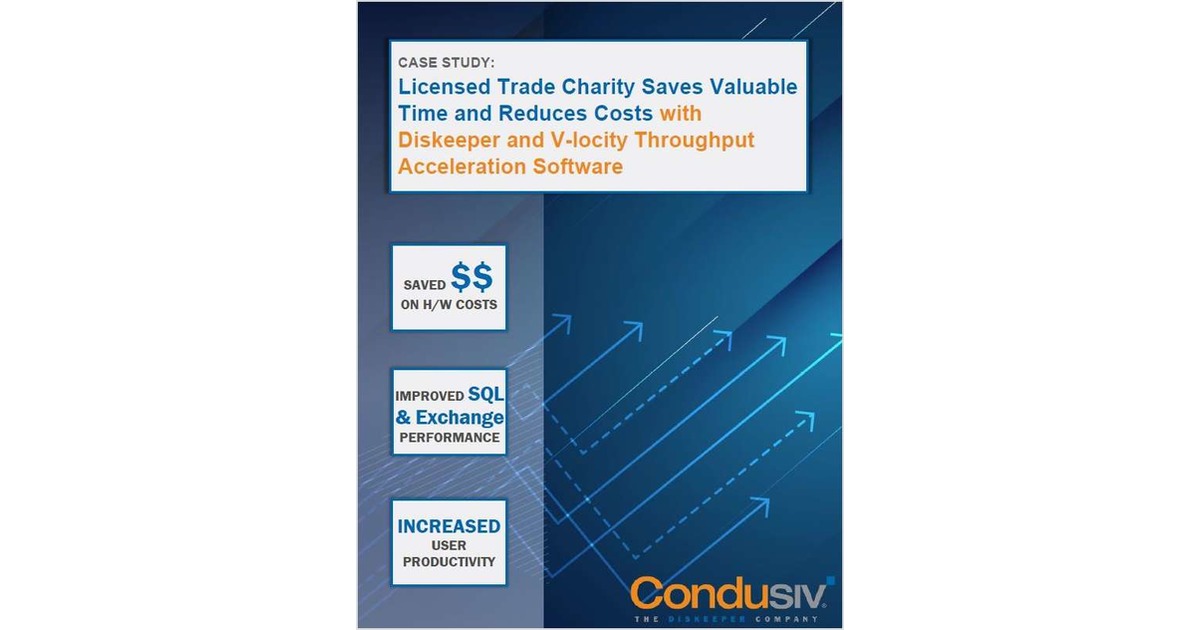
Licensed Trade Charity Saves Valuable Time and Reduces Costs with Diskeeper and V-locity Throughput Acceleration Software

When the Licensed Trade Charity had a problem with fragmentation on their physical servers, causing IT headaches and user complaints, they looked to Condusiv Technologies. The quick installation of Diskeeper® resolved all of their performance-robbing fragmentation issues overnight. Then when the evolution of virtual servers came about, it only made sense for the organization to continue its partnership with Condusiv and deploy V-locity. "We decided to try V-locity, which proved to make a considerable performance difference on our virtual servers,” said CIO of Licensed Trade Charity. In a recent 30-day data collection period, the Licensed Trade Charity discovered that the presence of V-locity on 58 of their servers is providing a significant storage I/O time savings of 12 days per server, on average. This represents the amount of time that the storage didn’t have to spend processing the excess, unnecessary I/O traffic. V-locity is able to eliminate this traffic from having to go to storage and back due to the way it increases storage I/O density, requiring fewer I/Os and allowing for faster data transfer rates. As the organization is currently migrating over to their new Nimble storage, the CIO reflected on the money saved, thanks to V-locity eliminating 25% of that storage traffic from having to go to the storage layer. “When we were looking at our options, we didn’t have to over-provision our investment in hardware, reducing our costs even further.” He continued, “We look forward to our ongoing relationship with Condusiv and seeing how well our new Nimble storage solution performs with our entire load moved over to it.”

Jun 17, 2026 8 min read Premium
C
ContentClik in Asset

SunCoke Energy Solves Months of Oracle Performance Troubleshooting with V-locity

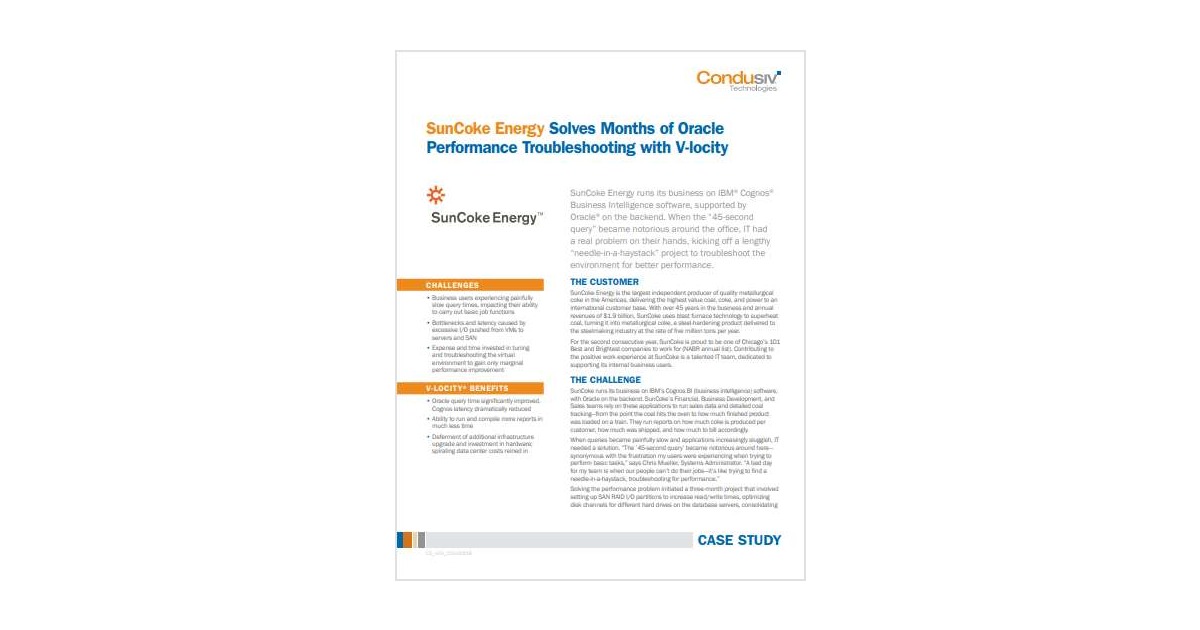
When SunCoke's “45-second query” became notorious around the office, IT had a real problem on their hands, kicking off a lengthy “needle-in-a-haystack” project to troubleshoot the environment for better performance. SunCoke runs its business on IBM’s Cognos BI (business intelligence) software, with Oracle on the backend. SunCoke’s Financial, Business Development, and Sales teams rely on these applications to run sales data and detailed coal tracking. When queries became painfully slow and applications increasingly sluggish, IT needed a solution. “The ’45-second query’ became notorious around here— synonymous with the frustration my users were experiencing when trying to perform basic tasks,” says Chris Mueller, Systems Administrator. “A bad day for my team is when our people can’t do their jobs—it’s like trying to find a needle-in-a-haystack, troubleshooting for performance.” Solving the performance problem initiated a three-month project that involved setting up SAN RAID I/O partitions to increase read/write times, optimizing disk channels for different hard drives on the database servers, consolidating all VMs, upgrading the server network from 1GB to 10GB, dedicating RAM and CPU to each Cognos server, and upgrading the Dell EqualLogic SAN to EMC VNX technology. “After all that, the infamous 45-second query went down to 25 seconds, which was nice, but not good enough,” explains Chris. “That’s when we brought in V-locity and it knocked the door down.” “We rolled out V-locity on all the Cognos VMs, ran the same query, and got the time down to 15 seconds instantaneously,” he explains. “I wish we had V-locity sooner—it would have saved massive effort and solved our problems much earlier in the process.” By deploying V-locity, SunCoke has reined in spiraling data center costs, delivered high performance to their users, and dramatically reduced backup time—driving greater value from the hardware and infrastructure they already have.
Jun 17, 2026 8 min read Premium
C
ContentClik in Asset

I.B.I.S., Inc. Doubles Throughput for ERP and CRM with V-locity I/O Reduction Software

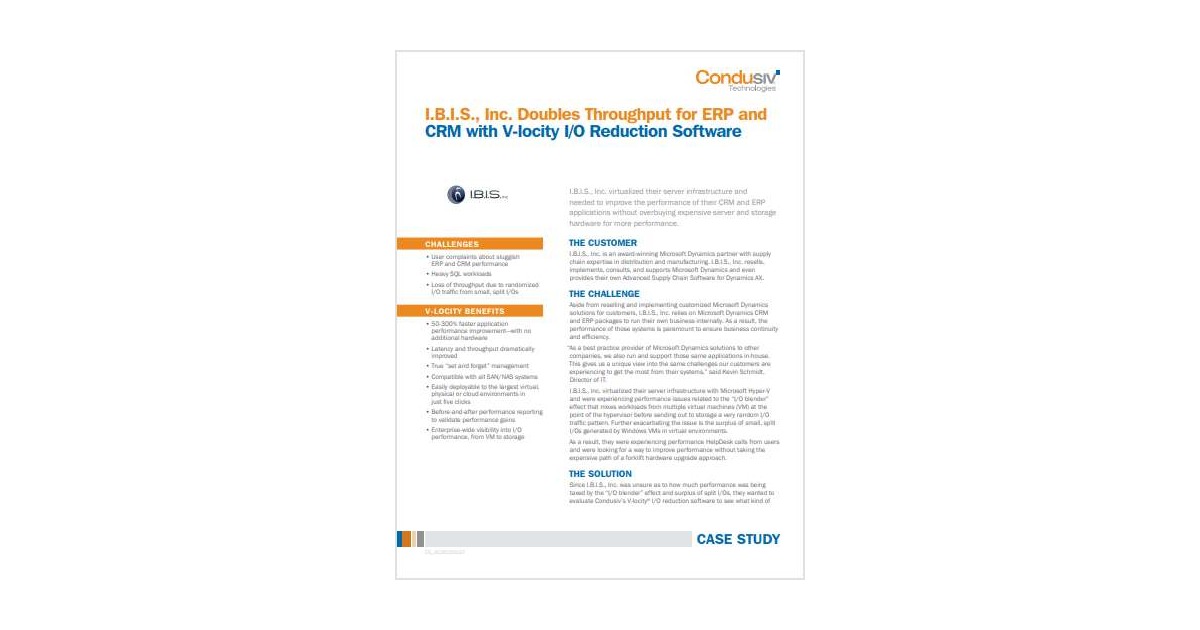
I.B.I.S., Inc. users complained about sluggish ERP and CRM performance, and faced heavy SQL workloads and loss of throughput due to randomized I/O traffic from small, split I/Os. I.B.I.S., Inc. virtualized their server infrastructure with Microsoft Hyper-V and were experiencing performance issues related to the “I/O blender” effect that mixes workloads from multiple virtual machines (VM) at the point of the hypervisor before sending out to storage a very random I/O traffic pattern. Further exacerbating the issue is the surplus of small, split I/Os generated by Windows VMs in virtual environments. They needed to improve the performance of their CRM and ERP applications without overbuying expensive server and storage hardware for more performance. Since I.B.I.S., Inc. was unsure as to how much performance was being taxed by the “I/O blender” effect and surplus of split I/Os, they wanted to evaluate Condusiv’s V-locity® I/O reduction software to see what kind of performance gains they could get on existing infrastructure. Kevin Schmidt, Director of IT, heard V-locity had helped other companies who virtualized SQL apps and needed significant performance gains, so he thought he would give it try. After deploying V-locity across their Windows virtual servers, I.B.I.S., Inc. saw an aggregate 75% performance improvement across all servers and put a stop to HelpDesk calls related to sluggish performance. The heaviest SQL workloads experienced the biggest performance gains with 120% improvement in data throughput. Schmidt continued, “Since we’re no longer dealing with so many small split I/Os and random I/O streams, V-locity has enabled our CRM and ERP systems to process twice the amount of data in the same amount of time. The best part is that we didn’t have to spend a single dime on expensive new hardware to get that performance.”

Jun 17, 2026 8 min read Premium

Ready for Full Access?

Gain unlimited access to our entire library of research briefings and analyst reports.

Unlock Full Membership
Access Granted
An Executive from a Global Firm just accessed Research Briefing