The Report Archive

A curated repository of research briefings and strategic analysis for the Report sector.

C
ContentClik in Report

VITEC Taps Industry Innovator, Eric Deniau, to Lead Research & Development Operations as CTO

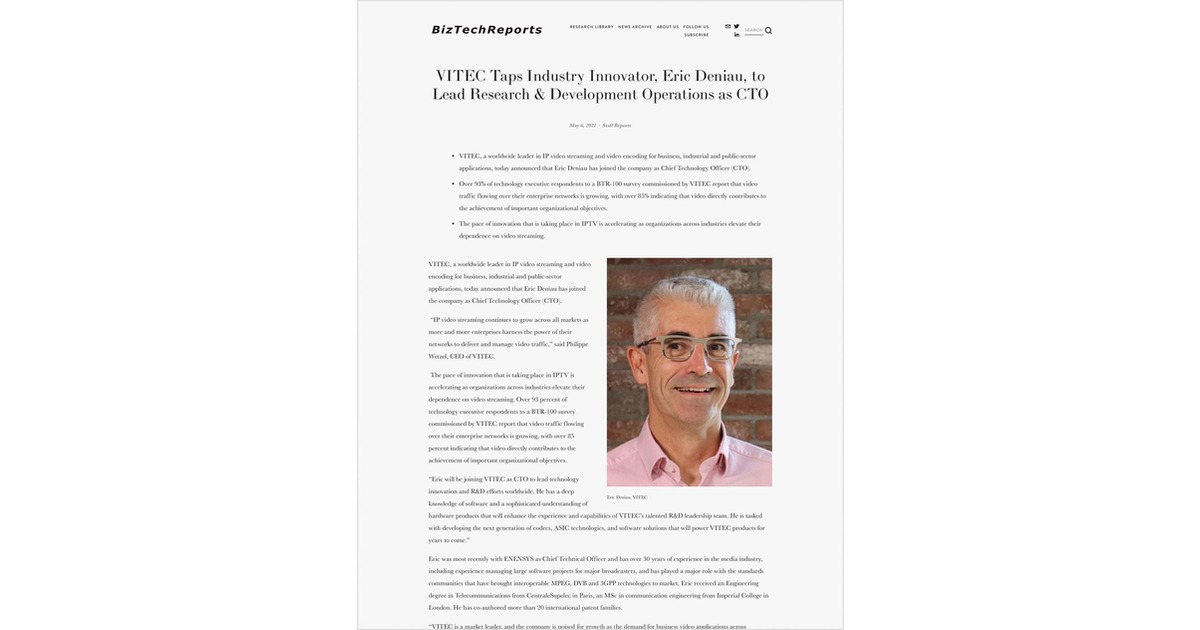
VITEC, a worldwide leader in IP video streaming and video encoding for business, industrial and public-sector applications, today announced that Eric Deniau has joined the company as Chief Technology Officer (CTO). Over 93% of technology executive respondents to a BTR-100 survey commissioned by VITEC report that video traffic flowing over their enterprise networks is growing, with over 85% indicating that video directly contributes to the achievement of important organizational objectives. VITEC, a worldwide leader in IP video streaming and video encoding for business, industrial and public-sector applications, today announced that Eric Deniau has joined the company as Chief Technology Officer (CTO). “IP video streaming continues to grow across all markets as more and more enterprises harness the power of their networks to deliver and manage video traffic,” said Philippe Wetzel, CEO of VITEC. The pace of innovation that is taking place in IPTV is accelerating as organizations across industries elevate their dependence on video streaming. Over 93 percent of technology executive respondents to a BTR-100 survey commissioned by VITEC report that video traffic flowing over their enterprise networks is growing, with over 85 percent indicating that video directly contributes to the achievement of important organizational objectives.

Jun 17, 2026 8 min read Premium
C
ContentClik in Report

Unveiling the Culprits: Understanding I/O Bottlenecks, Their Impact, and the DymaxIO Solution

Explore the ins and outs of I/O bottlenecks in IT infrastructure -- their origins, impact, and the game-changing solution provided by DymaxIO. Uncover the intricacies of split I/Os, learn how these culprits affect system performance, and discover why DymaxIO is the fast, easy, and cost-effective remedy. Dive into real-world case studies showcasing remarkable improvements, and start optimizing your storage with a free 30-day trial. Say goodbye to I/O bottlenecks and hello to enhanced efficiency! Embark on a journey into the heart of IT efficiency with our latest report, "Unveiling the Culprits: Understanding I/O Bottlenecks, Their Impact, and the DymaxIO Solution." Dive deep into the complexities of I/O bottlenecks, those persistent challenges faced by system administrators and database administrators. Explore the origins of I/O bottlenecks, dissecting the exponential growth in data volume and a key contributor—split I/Os. Uncover how these split I/Os lead to delays and sluggish performance, becoming a pronounced issue with the escalation in volume sizes and file proliferation. The article sheds light on the adverse effects of split I/Os, emphasizing their detrimental impact on storage performance. Delve into the repercussions of I/O bottlenecks, extending beyond inconvenience to slower data access times, potential delays in critical tasks, and increased wear on hardware components. However, amidst these challenges, Condusiv Technologies' DymaxIO® emerges as the optimal solution, offering a fast, easy, and cost-effective way to address I/O bottlenecks without the need for extensive hardware upgrades. Learn about DymaxIO's suite of intelligent technologies, including IntelliMemory® and IntelliWrite®, designed to elevate I/O performance. See how these technologies intelligently leverage available DRAM to cache frequently accessed data and revolutionize write operations by optimizing allocation at the logical disk layer. The result is expedited data retrieval, heightened system-wide responsiveness, and superior overall system performance. Discover the ease of implementing DymaxIO into existing environments, operating at the software level with minimal configuration. This non-intrusive approach enables organizations to enhance storage performance without the complexities and downtime associated with extensive hardware replacements. Additionally, DymaxIO stands out for its cost-efficiency, providing a streamlined solution that maximizes existing resources and mitigates the impact of split I/Os.

Jun 17, 2026 8 min read Premium
C
ContentClik in Report

Zero-Trust Adoption Driven by Data Protection, Cloud Access Control, and Regulatory Compliance Requirements

Zero-trust initiatives are a key focus for many companies. Nearly 30% of organizations are already rolling out zero-trust initiatives to control access to their data and assets and more than 80% will have the capability within the next 18 months. Organizations are addressing cybersecurity challenges by enhancing identity and access management, privileged-access management, and data classification. They expect to see budgets for zero-trust initiatives grow modestly over the next 12 months. Dark Reading’s 2023 Zero-Trust Survey of 124 IT and security professionals points to factors driving zero-trust adoption, including efforts to bolster data protection, enable better cloud access control, meet regulatory compliance requirements, and address risks related to a growing remote workforce. Many enterprises have implemented a zero[1]trust security strategy in the past year — or plan to do so over the coming 12 months — to address a variety of security use cases. By the end of 2024, more than 80% of the IT and security professionals in Dark Reading’s survey expect to have a zero-trust initiative in place at their organization. The primary drivers for zero-trust adoption are data protection, cloud access control, remote workforce[1]related risks, and regulatory compliance interest in zero-trust models cuts across organizational size and industries. Relatively small organizations and very large organizations appear to be adopting zero-trust approaches in equal numbers. Many of those who have deployed zero trust as well as those still in the process of doing so expect long-term benefits that extend beyond strong access controls and authentication. A high percentage of organizations already have key components in place for enabling zero-trust architectures. These include strong identity and access management (IAM) controls, multifactor authentication (MFA), single sign-on (SSO) capabilities, and endpoint detection and response mechanisms. Employing these controls, security and IT professionals mostly appear confident about their ability to address threats related to identity and access. But challenges remain, especially around password management, managing cloud access, enforcing least-privileged access, and managing privileged access. Over the next 12 months, many organizations plan to address these challenges by enhancing their capabilities in several of these areas — including IAM, privileged-access management, and data classification. A high percentage of respondents expect to see budgets for zero-trust initiatives grow over the next 12 months. Even so, the increases would likely be modest: The expected percentage increases tended to be on the lower side.

Jun 17, 2026 8 min read Premium

Ready for Full Access?

Gain unlimited access to our entire library of research briefings and analyst reports.

Unlock Full Membership
Access Granted
An Executive from a Global Firm just accessed Research Briefing