The Report Archive

A curated repository of research briefings and strategic analysis for the Report sector.

C
ContentClik in Report

Edge Computing Trends: Adoption, Challenges, and Future Outlook

This report shares insights on edge computing, gathered from a survey of IT professionals. Explore strategies for optimizing costs, extending security, and more. Edge computing — the practice of operating closer to end users rather than in centralized data centers — has been a hot topic in IT for years. Because edge architectures can reduce latency and improve performance, businesses have embraced them to address speed, security, and efficiency challenges. While these benefits have long been relevant, edge computing has become even more critical in the age of real-time data analytics and artificial intelligence. These workloads demand near-instantaneous processing, making traditional network architectures less viable. But how much of the edge computing talk is just that — talk — and how much reflects real-world adoption? To what extent are businesses actively deploying edge workloads? What challenges do they face, and what benefits do they see? To answer these questions, ITPro Today surveyed IT professionals about their organizations' edge computing strategies and investments. The survey results, which are detailed in this report, offer valuable insights into the current state of edge computing and where businesses plan to invest next at the network edge. For key survey findings, a deep dive into the survey data and its implications for modern IT strategies, download your free copy of our 2025 Edge Computing Trends Report today!

Jun 17, 2026 8 min read Premium
C
ContentClik in Report

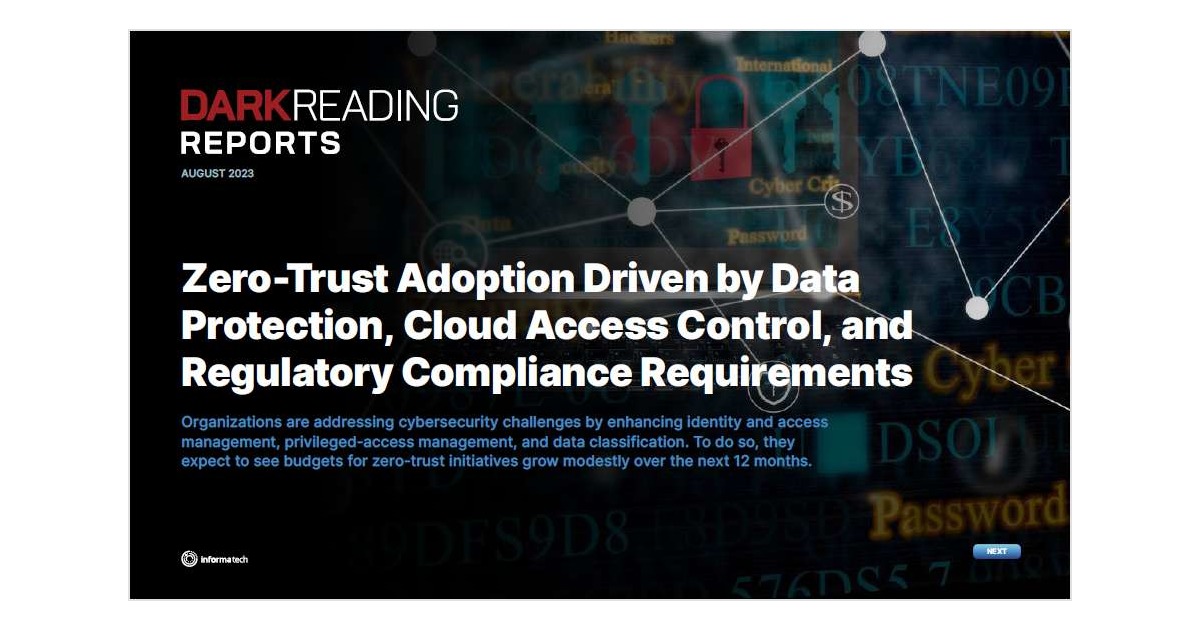
Zero-Trust Adoption Driven by Data Protection, Cloud Access Control, and Regulatory Compliance Requirements

Zero-trust initiatives are a key focus for many companies. Nearly 30% of organizations are already rolling out zero-trust initiatives to control access to their data and assets and more than 80% will have the capability within the next 18 months. Organizations are addressing cybersecurity challenges by enhancing identity and access management, privileged-access management, and data classification. They expect to see budgets for zero-trust initiatives grow modestly over the next 12 months. Dark Reading’s 2023 Zero-Trust Survey of 124 IT and security professionals points to factors driving zero-trust adoption, including efforts to bolster data protection, enable better cloud access control, meet regulatory compliance requirements, and address risks related to a growing remote workforce. Many enterprises have implemented a zero[1]trust security strategy in the past year — or plan to do so over the coming 12 months — to address a variety of security use cases. By the end of 2024, more than 80% of the IT and security professionals in Dark Reading’s survey expect to have a zero-trust initiative in place at their organization. The primary drivers for zero-trust adoption are data protection, cloud access control, remote workforce[1]related risks, and regulatory compliance interest in zero-trust models cuts across organizational size and industries. Relatively small organizations and very large organizations appear to be adopting zero-trust approaches in equal numbers. Many of those who have deployed zero trust as well as those still in the process of doing so expect long-term benefits that extend beyond strong access controls and authentication. A high percentage of organizations already have key components in place for enabling zero-trust architectures. These include strong identity and access management (IAM) controls, multifactor authentication (MFA), single sign-on (SSO) capabilities, and endpoint detection and response mechanisms. Employing these controls, security and IT professionals mostly appear confident about their ability to address threats related to identity and access. But challenges remain, especially around password management, managing cloud access, enforcing least-privileged access, and managing privileged access. Over the next 12 months, many organizations plan to address these challenges by enhancing their capabilities in several of these areas — including IAM, privileged-access management, and data classification. A high percentage of respondents expect to see budgets for zero-trust initiatives grow over the next 12 months. Even so, the increases would likely be modest: The expected percentage increases tended to be on the lower side.

Jun 17, 2026 8 min read Premium
C
ContentClik in Report

National Mortgage Lender Eliminates Sluggish MS-SQL Applications with V-locity I/O Reduction Software

Users complained of sluggish MS-SQL performance and expensive upgrades were not an option. Loan officers were complaining about sluggish performance of the most important application in the business: a loan origination system sitting on top of MS-SQL. Despite being supported by new Nimble hybrid storage arrays, Supreme Lending didn’t want to throw hundreds of thousands of dollars at new all-flash arrays to get better performance. Since V-locity I/O reduction software is free to evaluate, it was a “no brainer”...to try the software on their most troublesome MS-SQL systems and see what it could do. “We examined a couple server-side caching players including Pernix Data and Infinio, but since Condusiv’s V-locity does so much more than server-side caching, its proof of concept came out the clear winner on both performance and price. And we didn’t have to add any additional hardware, since we already had a good amount of DRAM,” said Chuck Keith, Director of Infrastructure, Supreme Lending. “Right off the bat, MS-SQL reporting that used to take five to ten minutes dropped to 30 seconds with V-locity, and all user complaints about sluggishness disappeared. We couldn’t believe it,” said Keith. “With V-locity I/O reduction software on our servers and Nimble storage for our backend, we feel we are getting best of breed performance at lowest possible cost.” Download the full case study to read more about why Supreme Lending feels they are getting the best performance at the lowest cost!

Jun 17, 2026 8 min read Premium
C
ContentClik in Report

Altenloh, Brinck & Co. U.S. Gets V-locity

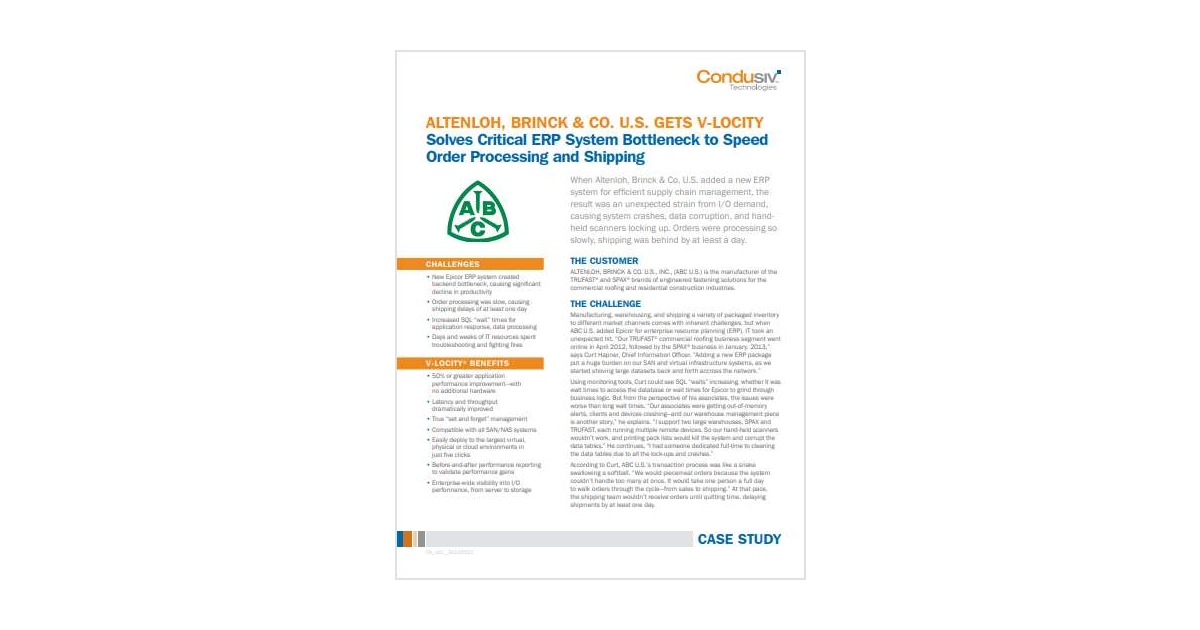
Solves critical ERP system bottleneck to speed order processing and shipping When ABC U.S. added a new ERP system for efficient supply chain management, the result was an unexpected strain from I/O demand, causing system crashes, data corruption, and handheld scanners locking up. Orders were processing so slowly, shipping was behind by at least a day. Curt, Chief Information Officer, was able to run V-locity on several VMs, looking for improvements in workload processing. “We hadn’t even purchased V-locity yet, and we had full access to support. The ease of getting up and running was excellent,” he explains. “We tested the waters and, once I was confident nothing was blowing up, we pushed V-locity to the ERP hosts. I wanted to see the results in context of our biggest trouble spots before making a decision to purchase.” Curt collected feedback from various business units, verifying V-locity’s impact. “Within days, I had reports back from shipping that scanners were no longer locking up, and there hadn’t been any system crashes,” he says.“That’s all the verification I needed.” Since rolling out V-locity a year ago, there have been no system crashes, device lock-ups, and corrupted data tables. The IT resource dedicated to fighting fires is now doing the job she was hired for. “By getting rid of I/O, V-locity solved our problems, and I saved about $250K in hardware costs,” he explains. “Performance has improved so significantly, orders move from sales to shipping in real-time, saving a day of productivity. Now our biggest problem is we can hardly keep up with the pace of the orders. We’re more efficient than ever and people are back to loving their jobs.”
Jun 17, 2026 8 min read Premium
C
ContentClik in Report

Bell Mobility Implements V-locity I/O reduction Software and Increases Workload Throughput By 98%

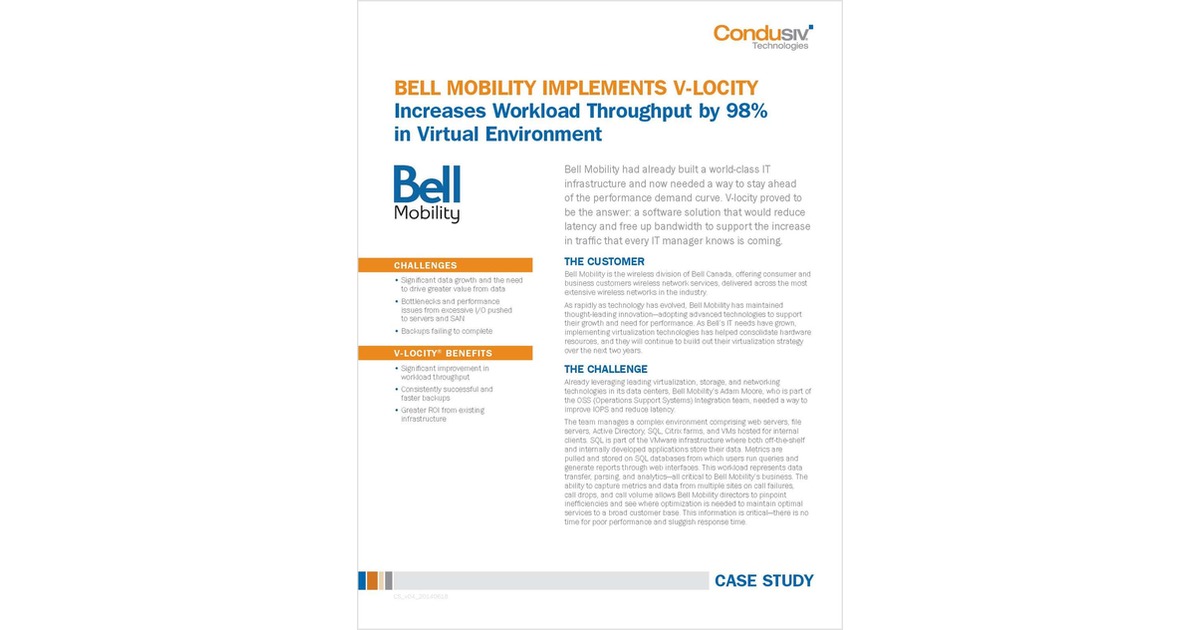
V-locity Reduces I/O to SAN by 61% for 3X faster SQL Report Queries Bell Mobility had already built a world-class IT infrastructure and now needed a way to stay ahead of the performance demand curve. V-locity proved to be the answer: a software solution that would reduce latency and free up bandwidth to support the increase in traffic that every IT manager knows is coming. Already leveraging leading virtualization, storage, and networking technologies in its data centers, Bell Mobility's Adam Moore, who is part of the OSS (Operations Support Systems) Integration team, needed a way to improve IOPS and reduce latency. The team manages a complex environment comprising web servers, file servers, Active Directory, SQL, Citrix farms, and VMs hosted for internal clients. SQL is part of the VMware infrastructure where both off-the-shelf and internally developed applications store their data. Faced with significant data growth—and a need for faster delivery of that data to meet SLAs with internal customers—Bell Mobility needed an efficient way to gain higher performance while reducing operational overhead—freeing the team to focus on more strategic initiatives. The team initiated an evaluation of Condusiv's V-locity I/O reduction software on 16 servers. With V-locity's embedded Benefit Analyzer, the team gained reporting functionality that demonstrated a 61% reduction in I/O to the SAN, freeing up bandwidth and enabling data to process 98% faster by eliminating bottlenecks caused by split I/Os.

Jun 17, 2026 8 min read Premium

Ready for Full Access?

Gain unlimited access to our entire library of research briefings and analyst reports.

Unlock Full Membership
Access Granted
An Executive from a Global Firm just accessed Research Briefing